
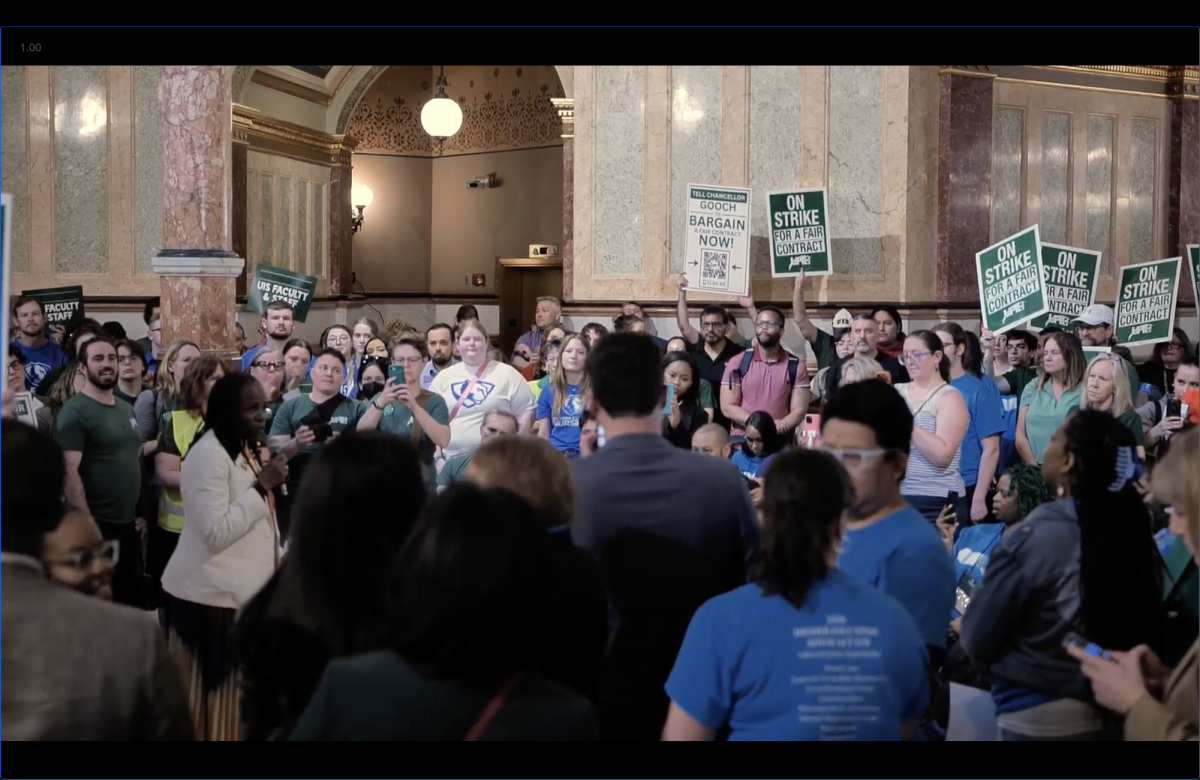
On April 16, Julissa Sepulveda, a friend and Jaguar Student Media colleague who works for Radio Jaguar, and I drove down to Springfield to cover Higher Education Advocacy Day. We made the trip to follow the push behind the Adequate and Equitable Public University Funding Act (HB1581/SB0013), the bill that would create a real, needs-based formula for how Illinois distributes money to its public universities.
The proposal calls for a $135 million annual increase over 15 years, with the goal of prioritizing schools that have been underfunded for decades, including Governors State. There’s also a companion bill, HB5037, the Fixing Illinois Higher Education Funding Act, which would examine cost drivers and lay out a 10-year sustainability plan.
The trip had been building for us for weeks before we ever set foot in Springfield. On campus, one of the professional unions, led by Mike Hart, had been setting up tables in the cafeteria to sign students up for free buses and lunch so more people could make it to Advocacy Days. Julissa sat in on a Student Senate meeting where President Ester personally asked students to come, and Dr. Ester ended up inviting Julissa and me to come down a day early, before the buses were even running, to cover her 8 a.m. testimony in person. So our journey began around 4 a.m. as we drove nearly three hours from our homes down to Springfield, trying to make it in time for the first event of the day. After a few stops and starts in finding the correct room, we took our place to hear the testimonials from university presidents before the committee, including Dr. Joyce Ester.
When we got to the Capitol, the rotunda was packed. The turnout downstairs was genuinely impressive, with students, faculty, union folks, and lobbyists all clustered together, making noise for the bill. Standing in the middle of it, you could feel it. But the second you started walking up to the second floor, the energy quieted, and by the time you reached the third floor, where the legislators actually spend most of their time, you could barely hear it at all. It made me realize that for a moment like this, the whole point is being seen by the people with the power, and unless folks make their way up to the upper balconies, that part doesn’t quite land. Still, the showing on the ground was real, and the people there clearly weren’t messing around.
Dr. Ester has been president of Governors State University for just under a year, and this was her first testimony in Springfield in her new role. In the same way that GovState students are expected to prepare, then step up and deliver for assignments and presentations, Dr. Ester showed up for her testimony in Springfield understanding the assignment: She arrived with hard data, one-page flyers called leave-behinds, and a chart in her presentation outlining GovState’s funding relative to the rest of the Illinois state university system across the years. It was clear that Dr. Ester wanted everyone to understand that GovState is the least-funded public institution in the State of Illinois.
In her words, Dr. Ester went into this experience with an “aggressive ask”: A direct ask for an over 50% increase in state funding for Governors State University. In comparison, other schools were asking for closer to 5, 10, or 16% increases. Following her presentation, one of the legislators in attendance actually thanked Dr. Ester for asking for as much as she did.
As Dr. Ester put it, if she didn’t ask for what we actually needed, no one else would do it for us. She was clear-eyed about the fact that she might not get the full ask, but she also wasn’t going to leave money on the table by aiming low.
Outside of the testimony, Julissa and I spent a chunk of the day with the folks from Lewis University, and that’s when we ended up in a hallway conversation with Rep. Marcus C. Evans Jr., a Democratic state representative from Chicago’s South Side and south suburban Cook County who has served in the Illinois House since 2012. He’s known in Springfield as a labor- and infrastructure-focused legislator, having chaired the Labor & Commerce Committee and now serving as assistant majority leader, with much of his work centering on labor rights, transportation, energy, healthcare access, and economic development for working-class communities. He was, hands down, the most politician-politician I have ever met in person. Every gesture, every line, every handshake had that practiced tone to it. It was kind of fun to watch up close.
One of the highlights of the day was being shown around by Juan Carlos Bautista, a lobbyist for the Latino Policy Forum. He didn’t have to help us, but he made sure to introduce us to the right people and sat us down with some of the lobbying groups pushing the bill through. We ended up talking to Blanca Jara from the government relations office at Northeastern Illinois University (NEIU), another mid-sized Illinois public university facing the same kind of funding pressures as GovState, along with Jennifer Juarez, also from the Latino Policy Forum, and Perla Santoyo from Advance Illinois.
What stood out to me was that the Latino Policy Forum isn’t an education-specific lobby; it’s a Latino lobby. According to Jennifer Juarez, the Latino Policy Forum is backing the Adequate and Equitable Public University Funding Act, because Illinois universities aren’t fully funded, which she said is driving up tuition, pushing more debt onto students and their families, and making it harder for students to graduate on time. As she put it, the bill is a holistic one that “really addresses a lot of the higher ed ills” the state has been letting build up for years. Incredible props to all of them for the work they do. It’s not flashy, but it’s the work that actually moves these bills and helps the communities.
The lobbyists also walked us through some real numbers. If GovState were fully funded under the new formula, we’d be looking at around $8.5 million instead of the $265,000 we ended up with for fiscal year 2026. They weren’t shy about pointing out that the 1% we got didn’t even cover a single $600,000 unfunded mandate, basically, a requirement the state hands a school without sending along the money to actually carry it out, which was rolled back by Gov. Pritzker in anticipation of larger federal cuts that would impact education funding. They also explained that this bill didn’t appear out of nowhere. A commission that started in 2020, made up of public institutions, legislators, and state organizations like IDHE, ran the numbers together for years before the bill was even introduced. Hearing that made the whole thing feel both much more real and like something people had been deliberately building and planning for a long time.
We also got to talk to a couple of people outside our usual GovState bubble. We sat down with one of our professors, Gerald Slowik, a senior lecturer in the Independent Film and Digital Imaging MFA program, who got real about funding cuts and how teachers, from kindergarten through higher ed, end up dipping into their own pockets to make their classes work. We talked to Dathan Powell, an Associate Professor of Theatre at U of I Springfield helping lead the faculty union effort there, whose campus was in the middle of a strike. And we caught up with a student from U Chicago, Meghana Halbe, who, beyond different schools, different situations, and different backgrounds, was there for the same reason as we were. As she put it, “Education is incredibly important, and it’s great to support this bill that aims to help people achieve that.”
Springfield itself is a funny town. The Capitol is genuinely beautiful, but two blocks out, the city starts looking a bit rough. There’s this strange contrast: the seat of state power sits right next to closed businesses and run-down empty lots. Being there in person was honestly worth it just for that, getting to see the people who actually make the legislation for our state, and also seeing the streets around it that hardly ever show up in the photo ops.
Before we left, the lobbying folks made a point of telling us how regular people can get involved in this fight. The big things: Look up your state senator and representative, call their offices, send letters, visit them in your district, or come down to Springfield, as we did. Submit witness slips when the bill goes up for committee, they literally count them when assessing support. Follow the bill (HB1581 and Senate Bill 13) on the ILGA website so you know when it’s time to act. The Coalition for Transforming Funding Higher Education, the Latino Policy Forum, Advance Illinois, PCC, Young Invincibles, and Women Employed all have newsletters and resources to help you stay plugged in.
After it all, I couldn’t get away from the feeling of being at the State House. That feeling that, at times, the day moved incredibly fast and, at others, surprisingly slow. Sometimes it felt like we were constantly rushing to be here or over there, and before we knew it, we had been sitting in a conversation with someone for much longer than we’d expected to. By the end of it, the takeaway felt simple: a lot of people who care about Illinois higher ed showed up, did the work, and aren’t planning to slow down. The bill is still moving, and based on what we saw, it isn’t slowing down until Springfield gives Illinois students the answer they drove all the way down there to get.
Julissa and I plan to keep following this story as the bill moves through the committee, and its effects are felt in communities like ours. If you’ve got tips, questions, or ideas for what we should cover when Jaguar Student Media reconvenes in the Fall, send them to: [email protected]