
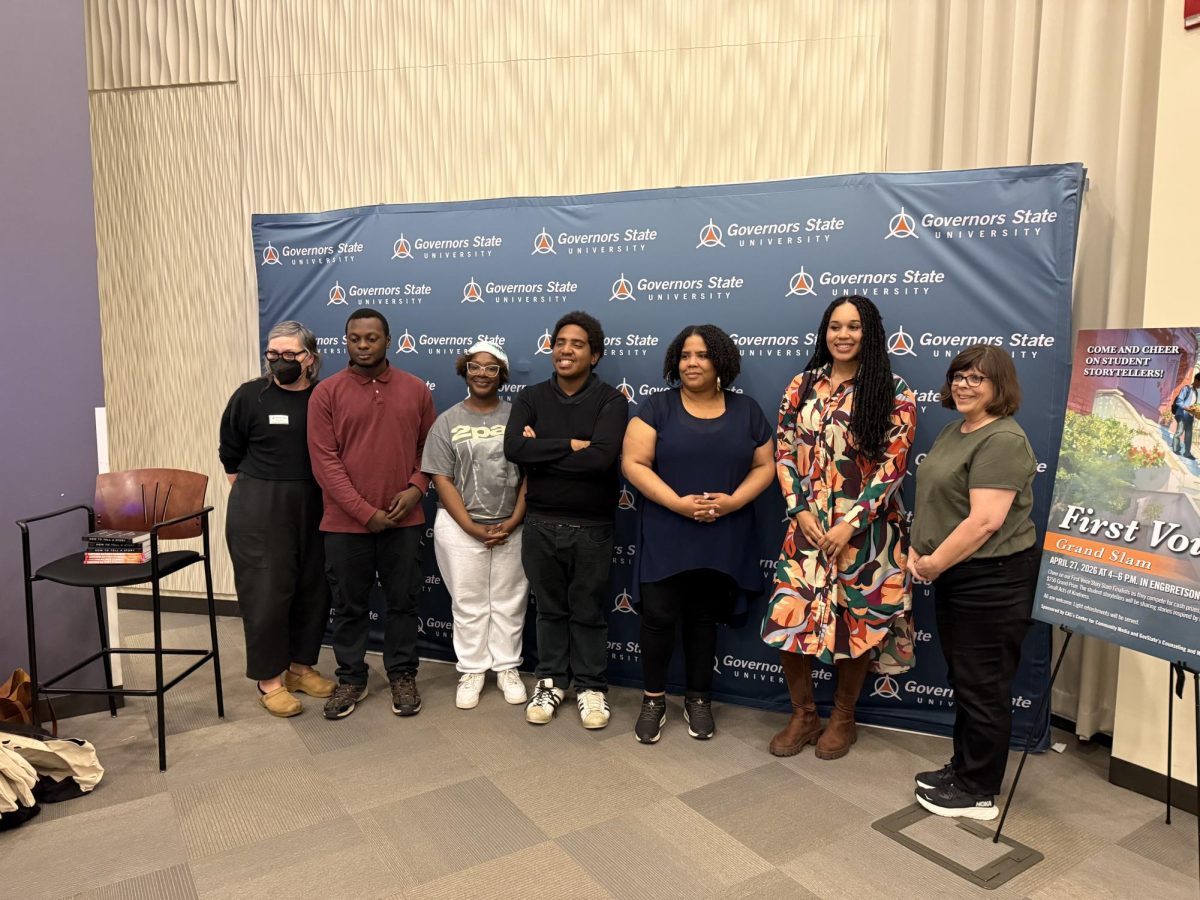
Media Across the Curriculum held the sixth annual First Voice Grand Slam, which is a continuation of the First Voice Story Slam. Finalists from the last event were invited to work with a mentor to refine their storytelling for the Grand Slam.
“They connected us with Eddie Gamboa. He specializes in public speaking. It was a good experience; he was very knowledgeable. We had a meeting via zoom. He listened to the story, broke down how we should discuss, and answered any questions we had.” said Camille Younger.
At the Grand Slam, five story tellers out of the seven finalists told their stories in 5-7 minutes with no notes and as if they were speaking to a friend.
Dr. Kerri Morris, one of the founders of the event, explained the origins of the event, which was a collaboration between another class, where students had to tell a story. The founders were encouraged to make the class project a school wide event that was eventually first held during pandemic. Morris said that she originally thought there wouldn’t be many attendees who wanted to tell a story. She was surprised when there was a much bigger turnout and willing participants than she expected.
Morris chose names out of basket to determine the order of the speaking finalists while Julie Keck, the director of the Center for Community Media, introduced the finalists to the stage, and the finalists told their stories one by one.
The theme for this year’s Story Slam was “Small Acts of Kindness,” focusing on the good people can do for others. To ensure support for students and faculty, a representative from the counseling center was present.
First place was Corina Alexander, whose story centered on being open to giving and receiving. Second place was Camille Younger, who shared the experiences of motherhood and working two jobs—as her friend unexpectedly surprised her with a home-cooked meal and a one-hundred-dollar bill. Third place was Jamille Younger, a participant in last year’s story slam, who shared his experience with mental health and anxiety. Honorable mentions were Yusuf Olugbile-Muhammad, who explored themes of advice and community, and Jamesina Collier, who spoke about people doing acts of kindness without expecting anything in return.
Overall, the participants felt that the experience was a good one, although nerve-wracking, “I was super nervous because I had never presented a story from my life in a competition, but so many people seemed to relate to me: feeling stressed out and worrying about what your next step in life is,” said Olugbile-Muhammad. Younger also felt that the experience was a good opportunity to tell a story in front of people, even if it may be ‘scary,’ “I had a lot of fun doing it, and would love to do it again,” she said.
The event’s goal of improving people’s story telling was also achieved, as many of the participants had a chance to exercise that skill. Furthermore, it created a sense of community for the students.
Collier explained that while the story telling was a good opportunity, she wasn’t expecting the connections and networking that resulted from the event. “I knew I had stuff in common with students, because we all go to the same school. But just hearing their stories and how such a small thing can impact someone. It just made me feel like, they say it takes more muscles to frown than to smile. I definitely see that; it costs nothing to be nice.”
The event has future plans of a workshop being held in the spring, as well as the two-part event of a story slam and a grand slam.