
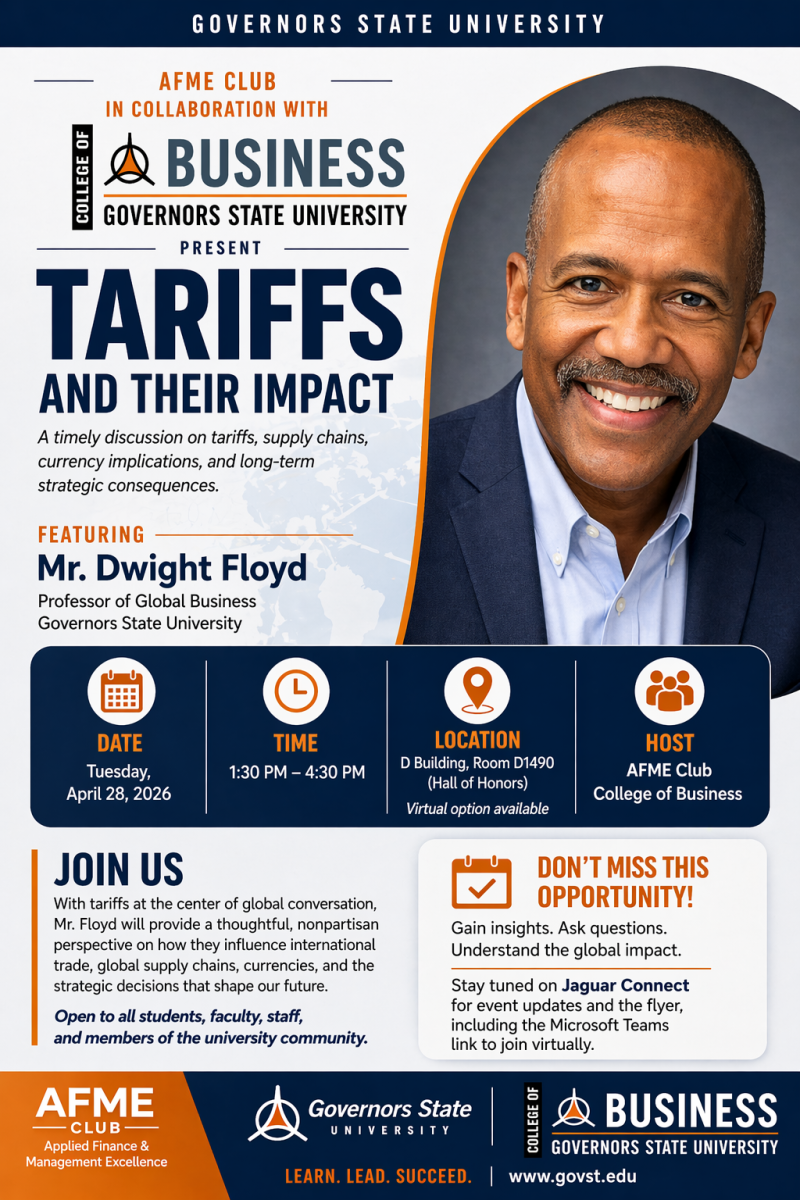
Students at Governors State University took a closer look at how global trade policies shape everyday life during a campus event hosted by the AFME Club in collaboration with the College of Business on April 28.
The event, “Tariffs and Their Impact,” featured Dwight Floyd, professor of global business, who led an in-depth discussion on how tariffs influence supply chains, pricing, currency dynamics and long-term economic strategy.
Speaking to students, faculty and staff gathered in the Hall of Honors, Floyd emphasized that tariffs are not just abstract government tools but policies with real and often immediate consequences.
“Tariffs don’t operate in isolation,” Floyd said. “They affect relationships between countries, businesses and consumers in interconnected ways.”
Floyd broke down complex economic concepts using real-world examples, helping attendees understand how tariffs can increase production costs, shift global supply chains and impact the availability of goods. He also discussed how businesses adapt to changing trade policies, often rethinking sourcing, pricing and market strategies to remain competitive.
The discussion also touched on broader global implications, including how tariffs influence diplomatic relations and economic partnerships between countries. Floyd encouraged students to think critically about both the intended and unintended effects of trade policies, particularly in an increasingly interconnected global economy.
Students actively engaged throughout the session, asking questions about how tariffs affect job markets, entrepreneurship and future career opportunities in business. The interactive format allowed many to connect classroom theories with current global developments.
Organizers said the event aimed to give students practical insight into economic issues that directly impact industries and decision-making. The AFME Club, which stands for Applied Finance and Management Excellence, regularly hosts events designed to bridge the gap between academic learning and real-world application.
The event was open to the university community and also offered a virtual attendance option, allowing broader participation.
As global trade continues to evolve, the discussion underscored the importance of economic awareness and adaptability, equipping students with knowledge that extends beyond the classroom and into their future careers.