
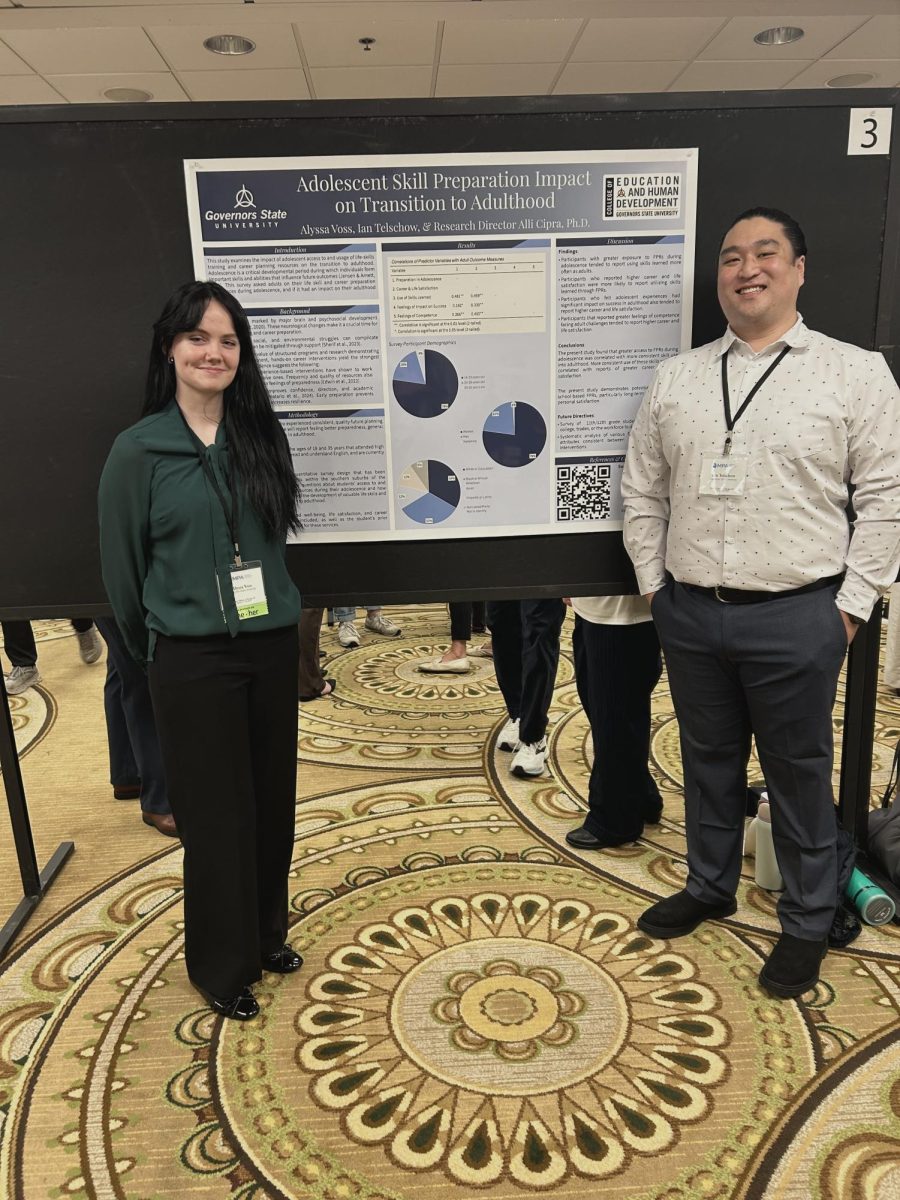
Students from Governors State University brought original, student-led research to a regional stage this spring, presenting at the Midwestern Psychological Association annual meeting in Chicago. They participated at the conference on April 10, 2026.
Alyssa Voss and Ian Telschow, members of Dr. Alli Cipra’s Social Development Lab, presented findings from a study they designed and conducted examining why adolescence is a critical period for developing life skills and preparing for future careers.
Their research focuses on how access to life skills training and career guidance during adolescence influences long-term outcomes, including well-being and life satisfaction in adulthood. The project builds on existing literature that identifies adolescence as a key developmental window for shaping behaviors and competencies that carry into later life.
What sets the study apart is that the data are entirely their own. Voss and Telschow created and distributed a structured questionnaire to college students ages 18 to 35 across the Chicagoland area, asking participants to reflect on their access to life skills and career-planning resources during adolescence and how those experiences impacted their transition into adulthood.
Their findings point to a clear pattern: participants who reported greater exposure to life skills and career preparation during adolescence also reported higher confidence, stronger feelings of preparedness for adulthood, and greater overall life satisfaction. The data also suggests a positive relationship between early access to these resources and long-term well-being, with many respondents indicating their skills were both useful and applicable in real-world settings.
The researchers used descriptive statistics, correlational analysis and thematic coding to analyze both quantitative trends and personal responses, offering a more complete picture of how these early experiences shape adult outcomes.
By presenting at MPA, Voss and Telschow joined students and researchers from across the Midwest in sharing work and engaging with professionals in the field. Their study contributes to broader conversations about how educational systems can better support students during one of the most formative stages of life.
The project also highlights the growing role of undergraduate research at Governors State, where students are not only learning psychological concepts but actively contributing to the field through independently conducted, data-driven work.