
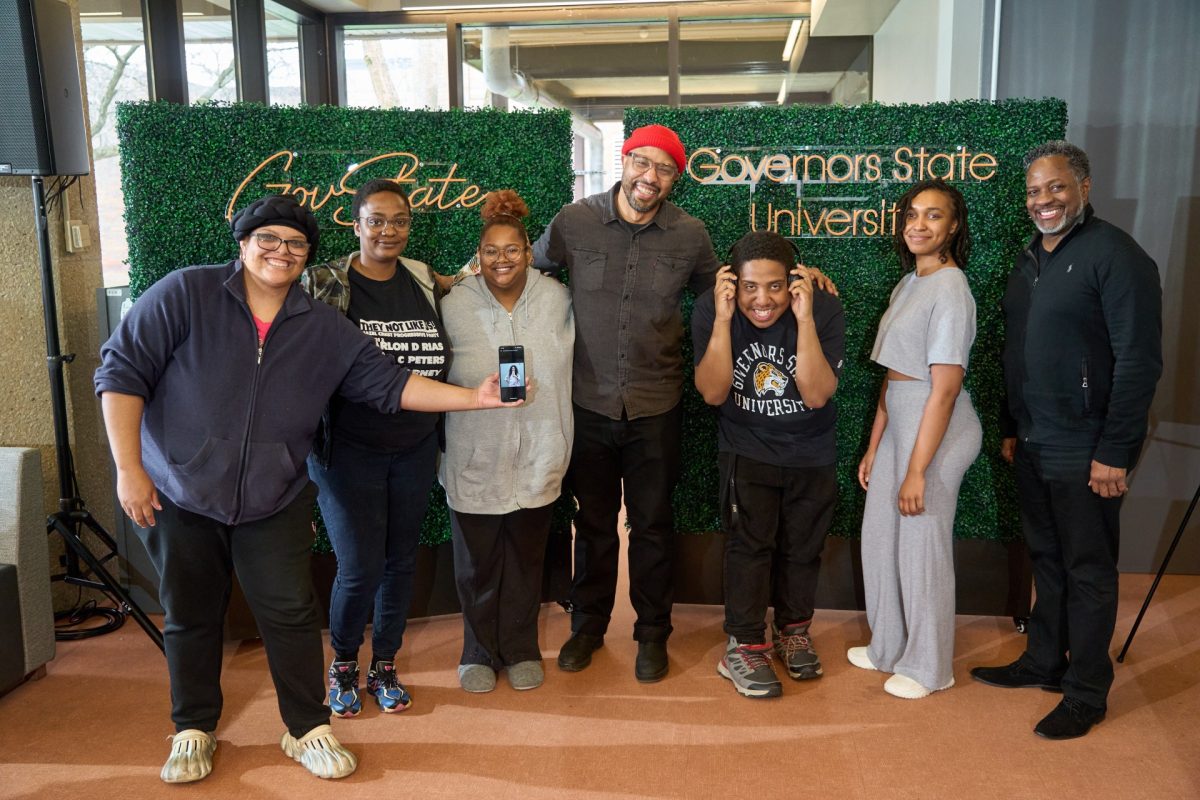
Governors State University’s sixth annual First Voice Story Slam is being held April 16 from 11:30 am to 1 pm. Students are invited to participate and share a five-minute story according to the theme of “Small Acts of Kindness.” Students will then be scored on their performance, and six finalists will be chosen for the Grand Slam, where students will refine their story and performance, to perform again for prizes and a 250 cash prize.
The First Voice Story Slam began as a class project in 2018. Dr. Kerrie Morris and Dr. Novia Pagone were working on a project that combined the two of their classes. Their students had to write a script detailing where they felt most comfortable on campus, the goal being to have the students present their story on camera.
The two professors continued to develop the project, choosing to focus on the idea of storytelling. At the end of their project, they took the students to a storytelling event, which was a great experience. This pushed the faculty members to create their own storytelling event, which began virtually in 2020.
Around the third annual event, professors began to work with the finalists to help them perform their story. “What we found was that the second round was so much better. What they tended to do was really focus the story much more tightly,” Morris said. Finalists are able to learn more about storytelling and choose what aspects they want to explore in the Grand Slam. Students are given tips to improve their storytelling, such as a way to end off the story or how to start.
“We had called this event different things throughout the year, and we landed on First Voice. Because I think that many of us have stories that we’ve never told. And I think storytelling is one of the ways that we find belonging, whether it is hearing stories of others, or telling our stories and having it be received by others. All of us need a witness to our lives.” Morris explained. Morris also said that the event allows others to connect with each other, despite their differences.
Julie Keck, the director of the Center for Community Media at GOVST. State, which focuses on teaching students writing, media production, camera work etc. The primary sponsor of the First Voice Story Slam is the Media Across the Curriculum program, whose goal is to help students develop those skills surrounding media work.
“This event, the story slam, is to encourage community focused storytelling as a skill,” she says. Media Across the Curriculum is partnering with the Counseling and Wellness Center to work together on creating the event.
Keck explains that the event is meant to prioritize student voices. “I feel like young people are often told, you don’t know enough yet. You don’t have enough experience to take up space. And we disagree with that. We think, especially in a university environment, the student voices are the most important ones. We just want to encourage everyone to take a moment, reflect on the theme.”
The finalists will get assigned to a storytelling coach that will work with the students to improve their storytelling efforts. Students are encouraged to tell a story from their personal experience as if they are telling a friend.
Jamille Younger, a finalist in last year’s event, stumbled across the event while it was happening. “I had no idea what was going on. When I first saw it, I was just passing it by. I was like okay; I want to do a part of that.” With no preparation, Younger chose to perform his own story. Chosen as a finalist for the Grand Slam, Younger was shocked. He worked together with a mentor to help his storytelling and learned what could be done to improve his storytelling.
Younger encourages students to participate in the event because it was “With artistic integrity everything you say or do has a story under it. Whether it’s music, whether it’s art, whether it’s dance, all of it has a story. It all depends on you on what you want that story to be.
As well as the event being fun for students, a place to build community, and a chance to be heard, there are also benefits for mental health. Angela Johnson, a social worker at the counseling center, mentions that they’re there to support students and to make them aware of the counseling center.