
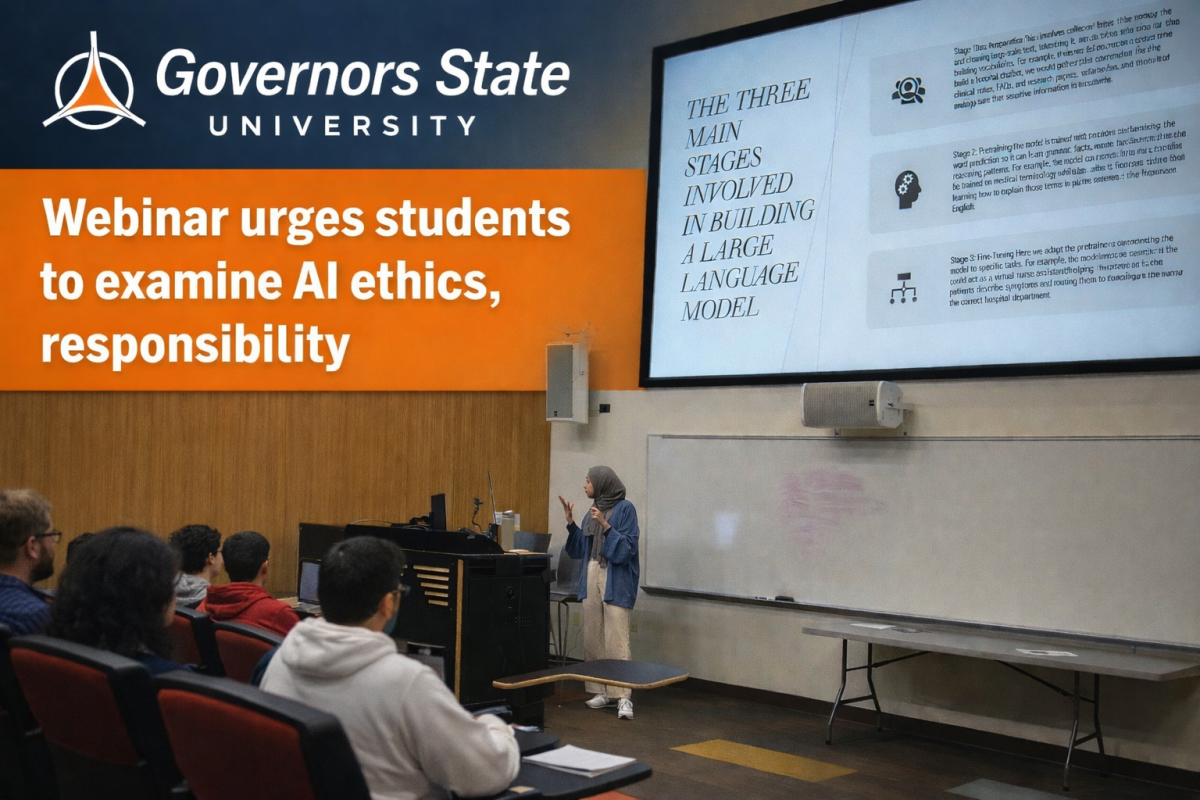
Governors State University hosted the webinar “AI Ethics: Navigating Responsibility in a Technological World” on March 30, featuring alumna Leen Abdel Karim, who explored the ethical challenges and real-world impact of artificial intelligence (AI).
As part of the Pathway to Success: Alumni Series, the session introduced students to AI as a field within computer science focused on creating systems capable of performing tasks that typically require human intelligence. Abdel Karim emphasized that while AI continues to advance rapidly, it must be developed and used responsibly.
“AI is a powerful and beneficial tool, but it needs to be used responsibly,” Abdel Karim said. “The future of AI is in our hands, and using it the wrong way can lead to serious ethical issues such as privacy concerns, bias, and job displacement. That’s why we should use AI the right way.”
The presentation traced the evolution of AI, beginning with Alan Turing’s early question of whether machines can think and the introduction of the Turing Test. Abdel Karim explained how the field experienced periods of slow progress, known as the AI Winter, before advancing significantly in recent years due to the rise of machine learning and deep learning technologies.
The session also outlined how AI systems are built through three key stages: data preparation, pretraining and fine-tuning. Abdel Karim noted that these processes rely heavily on large datasets, raising important concerns about privacy and ethical data use.
A major focus of the webinar was on ethical issues in AI, including bias, transparency, accountability and privacy. Real world examples were discussed, such as facial recognition systems showing higher error rates for darker-skinned individuals and hiring algorithms reinforcing gender bias.
“AI systems can inherit bias from the data they are trained on, which can lead to unfair outcomes in areas like hiring and law enforcement,” Abdel Karim said.
Students reflected on these challenges during the session. One participant, Jaylen Stingley, said, “The real-world examples helped me understand how AI bias can affect people in serious ways, especially in hiring and facial recognition.”
The webinar also explored broader societal impacts, including misinformation spread through social media algorithms, the risks of deepfakes and questions of accountability in cases such as self-driving car accidents.
Despite these concerns, Abdel Karim highlighted the positive potential of AI. She discussed how AI can support personalized learning in education and assist in disaster response through technologies like drones, ultimately helping save lives.
“Technology shapes everyday life, so who builds it truly matters,” Abdel Karim said.
The event was part of a broader spring series organized by Professor Tamisha Rose, Professional Lecturer in the Division of Science, Mathematics and Technology at Governors State University. Rose also serves as the Upsilon Pi Epsilon Theta Chapter Advisor and ACM Student Chapter Advisor at GovState, supporting student engagement in computing and technology-focused initiatives.
The session concluded by encouraging students to think critically about their role in shaping ethical and responsible AI systems. As artificial intelligence continues to influence various aspects of society, the discussion reinforced the importance of balancing innovation with accountability.