
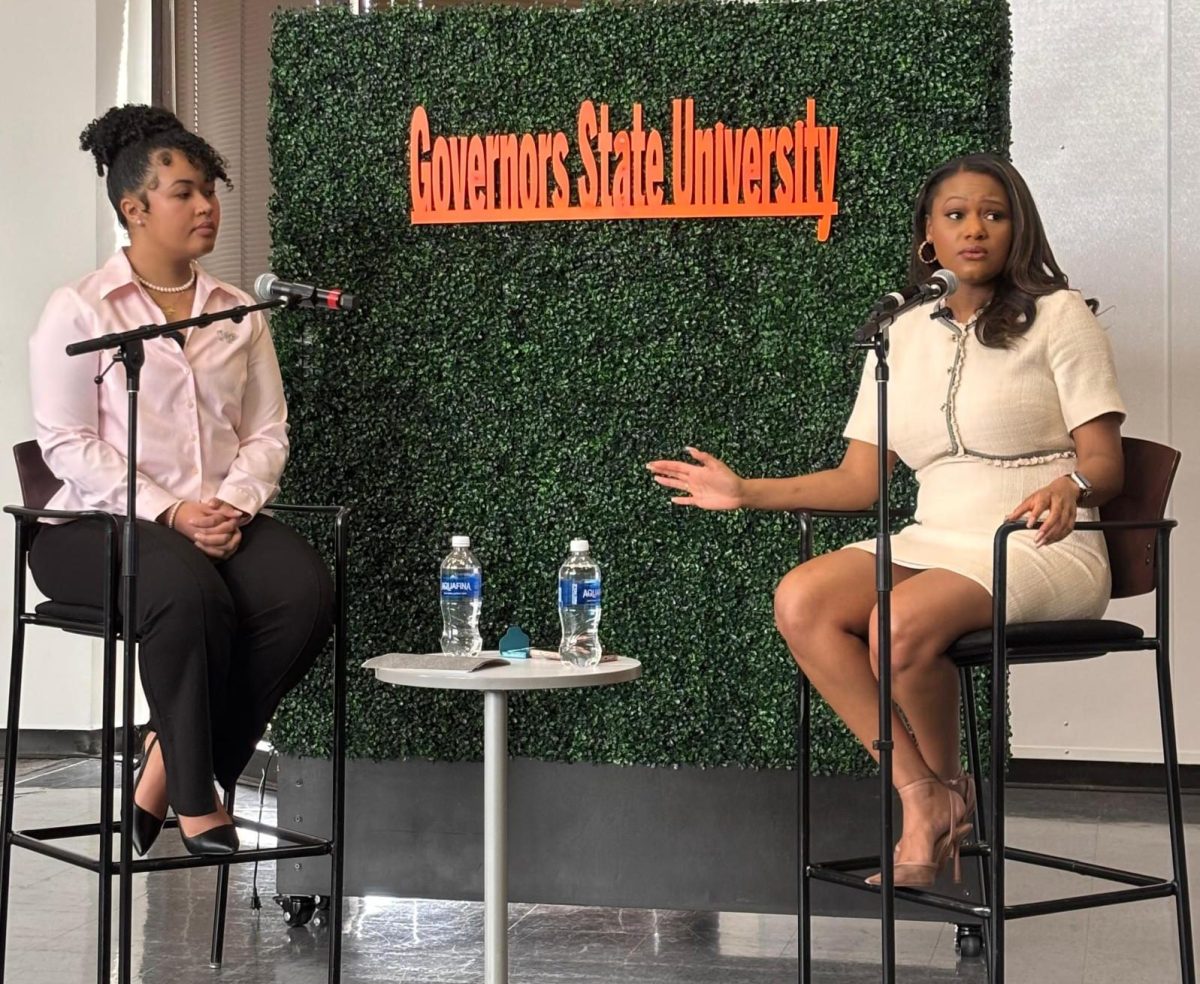
Standing before a room filled with aspiring storytellers at Governors State University, Emmy Award-winning journalist Samantha Chapman delivered more than career advice. She offered honesty, encouragement and a reminder that success in journalism begins long before a first job offer.
Speaking during a Women’s History Month event, Chapman, a Chicago native and consumer investigative reporter, shared her journey into journalism, the lessons she learned along the way and what continues to drive her today.
Chapman told students her path was not always straightforward. Although her mother believed she would become a strong news reporter, Chapman initially envisioned a future in teaching. That changed when her mother encouraged her to enroll in a six-week reporting course at Columbia College Chicago.
“That’s really what sparked my interest,” Chapman said. “I didn’t know then how much it would shape my future.”
Her early exposure to media also came from her father, a well-known DJ who introduced her to the world of broadcasting. As a child, Chapman often found herself around journalists and media professionals, an experience that helped her grow comfortable in those spaces long before she entered them professionally.
At the same time, her mother focused on building her confidence. Through pageants, Chapman learned how to speak clearly, think on her feet and engage with audiences skills she now credits as essential to her success.
“Being able to look people in the eye, speak confidently and answer questions you’re not expecting — those are things I learned early,” she said.
Throughout her talk, Chapman emphasized that while journalism continues to evolve, its foundation remains the same: accuracy, preparation and integrity.
“Mispronouncing names and not doing research is a big no,” she said. “Those are things you can control.”
She acknowledged the growing influence of social media and digital platforms, noting that today’s students have more opportunities than ever to create and share their work. Still, she cautioned against focusing solely on viral content.
“You don’t have to go viral to be impactful,” Chapman said. “Create content that has substance, something that matters to you.”
Encouraging students to take initiative, she stressed that building a portfolio no longer requires waiting for internships or professional opportunities.
“You can start right now,” she said. “Use your phone, tell stories on your campus, build your reel. There’s no excuse not to begin.”
Chapman also offered a realistic view of the industry, sharing stories from her early career as a multimedia journalist. In her first role, she was responsible for shooting, writing and editing her own stories, often working alone in unpredictable and challenging conditions.
She recalled reporting during a snowstorm, navigating unfamiliar situations and learning through trial and error.
“You’re not going to know until you get out there,” she said. “There’s always going to be a learning curve.”
At one point, Chapman was even asked to step into a weather reporting role despite not having a background in science. While she considered pursuing meteorology, she ultimately chose to stay true to her strengths in storytelling and reporting.
“I had to be honest with myself about who I am,” she said. “I’m a journalist.”
Today, Chapman said her motivation extends beyond telling stories it’s about making a difference in people’s lives. In her role as a consumer investigative reporter, she frequently helps individuals resolve issues they cannot fix on their own.
Many of those cases, she noted, never make it to air, but they remain deeply meaningful.
“Sometimes it’s $60, sometimes it’s $500 but it matters to that person,” she said. “And that matters to me.”
Her commitment to advocacy journalism led to one of her most significant accomplishments: contributing to the passage of the Illinois Squatter Law. Her investigative work helped highlight the challenges homeowners faced with squatters, ultimately leading to legislative change and earning her an Emmy Award.
Beyond her professional achievements, Chapman spoke about the importance of representation. As a Black woman from Chicago’s South Side, she understands the impact of visibility in media.
“There are little girls watching who see themselves in you,” she said. “That’s something I don’t take lightly.”
She also addressed the importance of supporting other women in the industry, encouraging collaboration over competition.
“We don’t have to compete against each other,” she said. “We can lift each other up.”
Chapman highlighted the value of diverse perspectives in journalism, explaining that newsrooms benefit from voices with different backgrounds and lived experiences. Without that diversity, she said, stories risk being incomplete or misunderstood.
“It’s important to have people in the room who can say, ‘This is how my community sees this,’” she said.
As the conversation turned to career preparation, Chapman advised students to present themselves professionally when applying for internships or jobs. She emphasized the importance of having a polished resume, a strong portfolio and a willingness to do both the visible and behind-the-scenes work.
“Show me that you’re serious,” she said. “Not just on camera, but in the work you’re willing to put in.”
She also encouraged students to be patient with their growth, especially when it comes to building credibility.
“Give yourself time to learn the basics,” she said. “And when you tell stories, make sure you’re giving multiple perspectives.”
While acknowledging concerns about misinformation and the entertainment-driven nature of modern media, Chapman expressed confidence that audiences will continue to value truth and authenticity.
“People still want real stories,” she said. “They still want honesty.”
As the event concluded, Chapman reflected on the legacy she hopes to leave behind one rooted in compassion, advocacy and trust.
“I want people to say that I cared,” she said. “That if nobody else had their back, I did.”
For the students listening, her message was both practical and personal: Start now, stay grounded in purpose and never underestimate the power of telling stories that matter.