
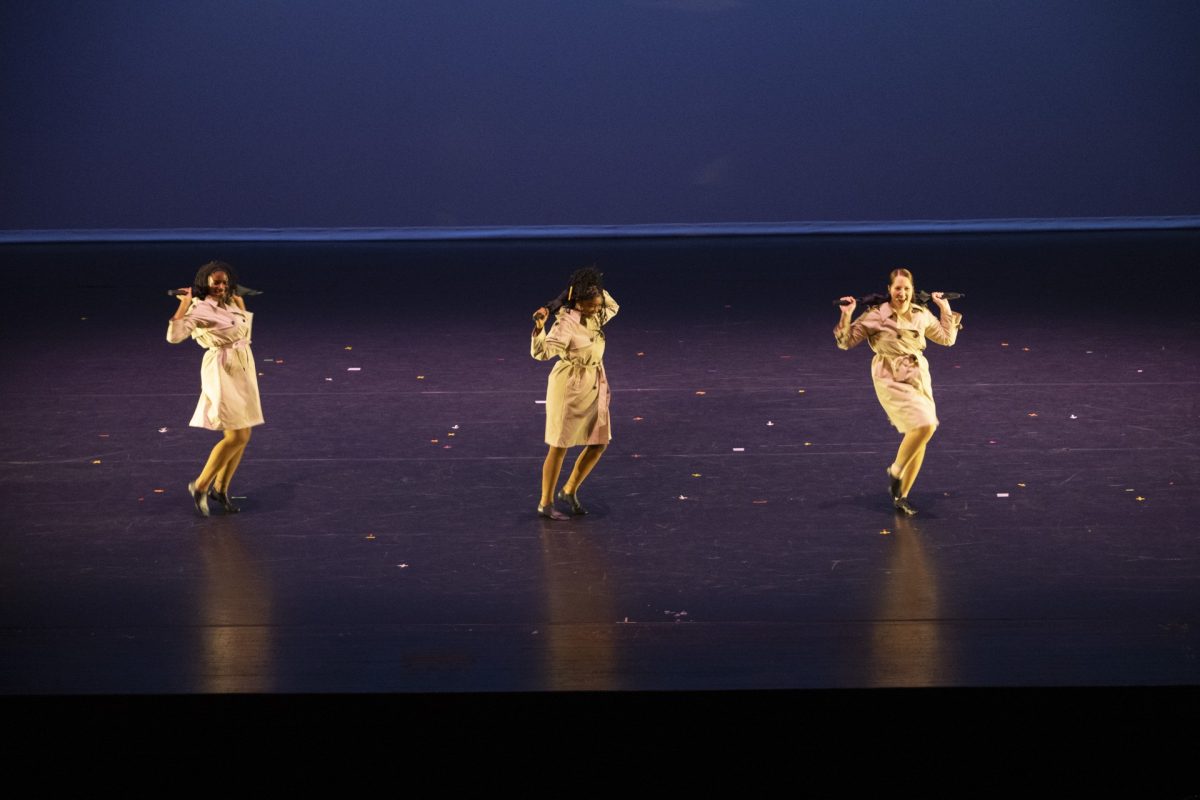
“All That Jazz” scorched the stage of the Center for Performing Arts on Saturday, March 7, with two shows directed by Megan Lindsey, a GovState faculty member, that paired modern and traditional jazz with dance and themes that ranged from the fun and personal to ones that touched on racial issues and the current political climate.
The show had two acts with a 15-minute intermission and 11 pieces. With a variety of choreographers among alumni, students, and a collaboration with the Jaguar Drill Team, the show presented many different styles of jazz and concepts that coincided with the theme of American jazz.
The Jaguar Drill Team and the dance company usually collaborate once a year to include a piece in a show. Inala Bruce-Rose, a member of the GovState Jaguars Drill Team, mentioned that a lot of collaboration and rehearsal is needed to ensure that the piece aligns with the theme of the other dances.
“Our president, Niyah Cannon, picked the song for the show,” she said. “I designed the graphics that showed up on the background. And then me, Niyah, and Daya Hendricks all coordinated to choreograph the dance and the equipment used on stage.”
In a Q&A session after the show, Bruce-Rose mentioned that it can be challenging at first to choreograph the perfect piece. “It took us a couple of weeks to figure out how we wanted the choreo to go, because when you do drill performances, you’re telling a story,” she said. “You have to make sure the dance and the equipment matches the story you want to tell. It takes a lot of crafting with the costumes and the coordination with what equipment we want.”
Everyone collaborates to create a piece perfect for the show, often participating in long night rehearsals three or four times a week to prepare. It’s Bruce-Rose’s third year performing in the collaborative piece between the dance company and the Jaguars Drill team, and she believes this was their best one yet.
The Q&A was held to allow the audience an opportunity to ask the choreographers, dancers, and the director questions about the show, inspirations, and the typical rehearsal process. As many involved with the show sat down on the stage, each began sharing how many years they had been dancing, how many years of experience they had dancing professionally, and their inspirations.
Among the GSU dance company, there are a variety of dancers with different experience levels. Some of the dancers are graduating this year, meaning that “All That Jazz,” was their last show as student dancers.
“It is so bittersweet to see the growth in everyone since my first show with you guys,” said Nicole Thompson, a dancer in the show. “To see people leave, see people come back and choreograph. It’s really inspiring for me, especially seeing people like My’Anna Perdue, Jazmin Butler, Sadee Wuethrich and their professional career, to keep going on.”
The dancers also were asked about their methods to prevent dance related injury during rehearsal. Butler has many methods to prevent injury: “Protein, resting, stretching, and warming up, making sure to do cardio before warming up.”
However, as important as warm ups are, knowing when to rest is just as important. “As far as dancers go, I feel like we can accidentally overpush ourselves, because it is a passion and we love it,” Butler said. “I think that something else to prevent it is knowing when to rest.” She says that ice and taking a day to sleep would also be beneficial to preventing injury throughout the show.
Asia Washington, a first year dancer at the GSU dance company, says that the experienced dancers also help prevent injury. “Sadee Wuethrich has helped us a lot by making sure we’re doing any stunts or flips correctly, so that we can stay safe. We have a lot of experienced dancers that can guide us to make sure we stay safe.”
Wuethrich is an alumni from GSU, and choreographed five pieces in the show. Her piece in act one, “Do we have a deal?” was meant to explore the feelings of being looked down upon in a place of employment. “That was more so about that over-powerment you might face in your job. People above you that think there better than you, when you have more to show.”
Most of the dancers agree that costume design and dances are based on what the choreographer is trying to achieve. Aja Unger says that the costume design is up to the choreographer, unless the dancer feels like something needs to be changed. “I just started doing jazz during my freshmen year,” she said. “I’ve been learning about jazz during classes. It’s a nice concept and very intricate, it’s close to contemporary but it still has certain types of steps to it.”
“Jazz is a very broad and diverse form of dance,” said Butler. “We only had a couple of pieces that had the stereotypical and traditional jazz, whereas the rest of it was mores contemporary jazz, hip hop jazz, jazz pop. I think that’s the way that we wanted to showcase the production. To showcase how there’s so many different types of jazz, not just the stereotypical surface level jazz,” introducing audience members to a deeper understanding of how versatile jazz is.
When asked about preparation before the show, Butler explained that practice is the most important element. Practice is done at rehearsal, and at home. But as well as preparation for the dance, Butler also believes that there is a lot of mental preparation involved. Her mental preparation includes praying, getting to know her cast members, and being comfortable with others involved in the show.
Lindsey, the director and a faculty member, teaches many dance classes at GSU, some directly about jazz, its history and its variety. Thompson took some of those classes: “She taught me how broad the spectrum of it is, and that it actually started with West African dance and European style dance meshing together. I think that is my favorite part about it, so many styles meshed into one.”
She believes that Jazz is a consistently evolving art, but she prefers traditional jazz. “I wish we could have showcased that a little more in the show,” she said. “I think this show was more focused more on message behind dancers. So for example, Strange Fruit by Nina Simone. (RW: Strange Fruit originally was sung by Billie Holliday in the late ’30s. It became one of her signature songs. I assume that Nina Simone’s version was used in this production.) That was a powerful message, but a little more contemporary ballet jazz versus traditional jazz, because of the political climate we’re in right now.”
The song “Strange Fruit,” was included in a dance piece titled “Echoes Beneath the Trees,” choreographed by Marquis Parks. “Echoes Beneath the Trees, with Nina Simone, is a very powerful dance because of everything that’s going on right now with racism and white supremacy. Right now, we feel that people are not stopping and addressing the issues,” Thompson explained. “We were trying to personify trees. Nature remembers everything, so that song is dedicated to the lynchings in the South, and we were just saying that even though time moves on, we still need to remember. Just like trees remember, rocks remember, rivers remember. We need to remember the things that have oppressed us, and then how to move forward but still grow, as a tree does.”
Marquis Parks, the choreographer of “Echoes Beneath the Trees,” had the dancers freestyle dance to certain words and themes to prepare. Thompson says that words like confidence and sorrow were given as themes, and the dancers were supposed to freestyle conceptual dance before they began the actual choreography for the show.
“My very first rehearsal, we did not dance. I wanted us to understand intention, to understand that we all have a story to tell. We all have a perspective to that story, so in order for us to truly do the dance, we must understand the dance. Understand the song, understand the movements that would create this piece,” Parks said, explaining the reason behind this method of rehearsal. He also frequently seeks insight from the dancers, and how they felt about rehearsal.
Regarding his inspirations of “Echoes Beneath the Trees,” Parks discussed the importance of history and where he got his idea. “That idea originated from some of the hangings and lynchings back in the 1950s and before,” he said. “I wanted to portray that with a modernized style, to find a connection within jazz, to really emote these ideas. Make people uncomfortable. I think I get more fulfillment when I’m able to make that uncomfortable move for people to talk about some of the history we don’t talk about.
“We are social justice forward. I sometimes feel our world is on fire. We are in so many positions in our world, where peace isn’t something that is forward, and that is what we look for.”