
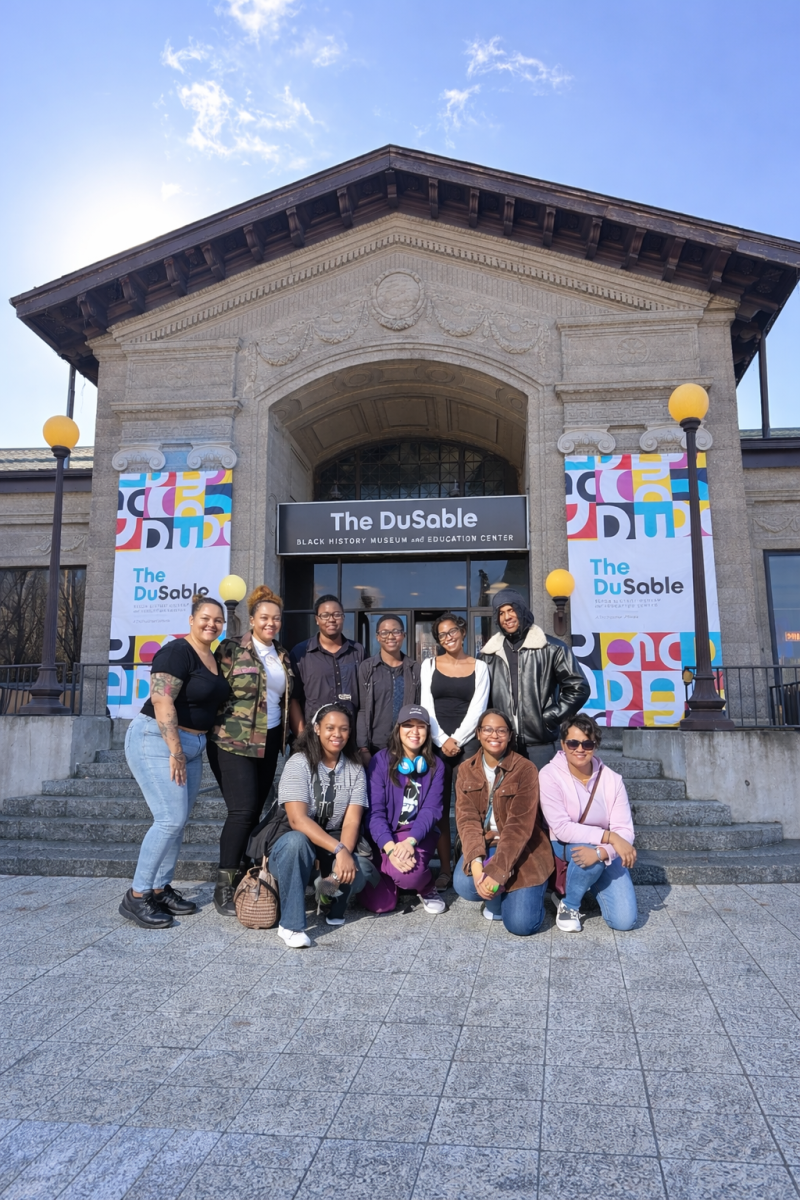
A “Paris in Black” event at the DuSable Black History Museum and Education Center highlighted a lesser=known segment of the Black cultural experience, adding a new perspective to Black History Month.
From the 1890s until the middle of the 20th Century, Black artists migrated from the United States to Europe to escape American racism and find the freedom to create. At the heart of this international movement was the New Negro Movement, an intellectual and cultural awakening in the early 20th Century that later laid the groundwork for what became known as the Harlem Renaissance.
Danielle Austin, Coordinator Of Civic Engagement And Intercultural Education at GovState, organized the trip to the museum on Feb. 18. Walking into the museum felt powerful, especially after learning that it had recently celebrated its 68th anniversary. At the entrance, Haris Dety, the Education manager, introduced visitors to the founders and the mission of the museum, which helped set the tone for the visit.
Being in a space created to preserve Black history and culture made everyone on the tour slow down; it felt like stepping into a living space of memory, creativity, and resistance.
What stood out was the realization that the Harlem Renaissance was not limited to Harlem but was part of a global Black Renaissance that included cultural awakenings in cities like New York, Chicago, and Paris. Paris offered a welcoming atmosphere compared to the segregation artists faced at home, and that freedom helped shape creative expression that later influenced Chicago’s own Black Renaissance during the 1930s–1950s.
Within the galleries, more than 100 artifacts told the stories of artists whose lives and work were shaped by this international exchange. Seeing the names and stories of people like Josephine Baker, Archibald Motley, and James Baldwin made the exhibition feel personal and real. Even many of those artists who did not physically move to Paris, were still deeply inspired by French artistic expression and by the work of Black American artists living abroad. This cross-cultural exchange showed how internationalism became essential to the power and legacy of the Black Renaissance.
One moment that really stayed with me was seeing a historic flag of the 8th regiment of the Illinois National Guard. This unit, composed of all Black soldiers, fought in France during World War I. Its motto was “One Country One Flag,” supplemented by the quote attributed to Franklin A. Denison: “We will bring these colors back with honor, or we will not come back at all.”
French Gen. Joseph Vincedon spoke about how the blood of French soldiers and Black American soldiers mixed on the soil of France, creating an unbreakable bond, illustrating how Black soldiers fought for freedom abroad while being denied full freedom at home.
Another captivating exhibit was Equiano.stories, which examines the question: What if an African child in 1756 had Instagram while he was being enslaved. The project reimagines the childhood story of Olaudah Equiano through short videos, images, and text, as if he were recording his life through social media. Seeing his early life in the Igboland village of Essaka before enslavement powerfully reminds visitors that his story did not begin in suffering, but in freedom, family, and community. The shift from freedom to captivity felt even heavier because it showed what was taken away, while still showing strength, resistance, and humanity during the Middle Passage.
On the trip back to campus, the mood on the bus felt quieter and more reflective than when we started. All participants were given snacks Black History Month gift bags, which felt like a small but thoughtful way to close out such a meaningful day.
Overall, this trip felt less like a class activity and more like a real cultural experience. Learning about the Black Renaissance in Paris, seeing the legacy of Black soldiers in France, and experiencing Equiano’s story through modern technology provided a deeper perspective on Black global history and the importance of spaces that protect and honor these stories.