
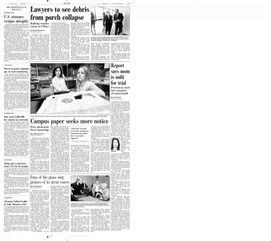
After 25 years, the Phoenix is changing its name starting in the fall of 2026. GovState’s student newspaper will be known as the Jaguar Chronicle.
The new name was selected by a staff vote following a survey of students conducted earlier this year. The Phoenix name has stood for something powerful and has been the voice for GovState students for a very long time.
The original newspaper at Governors State University started in March 1972 as The Innovator. For about three decades, it covered everything from campus news to student opinions. The Innovator was the voice of the student body until October 2000, when the newspaper stopped publishing. According to the Student Press Law Center, Dean Patricia Carter had contacted the paper’s printer and told them not to print any issues until a school official approved the content first.
Student journalists Margaret Hosty, Jeni Porche, and Steven Barba believed they were being silenced for writing articles that criticized the university administration. The three students weren’t going to let it go quietly. In 2001, they sued the university, arguing that their First Amendment rights had been violated. The case is known as Hosty v. Carter, which became a major legal battle over student press freedom at the college level.
Carole Schrock, now Carole Sharwarko and a senior reporter at the Lansing Journal, was a student at GovState pursuing her Master’s in Media Communication when the Phoenix was created. She was previously the editor-in-chief at Joliet Junior College’s newspaper, The Blazer. She had come to GovState with a passion for journalism, writing, and social causes. “I grew up in a household that valued news and journalism,” Sharwarko said. “From the start of my college journey, I was determined to pursue journalism.”
When Carole arrived at GovState, she immediately sought out the newspaper at the activities fair. She met the editors and was impressed by their enthusiasm, but after reading an issue, she had some concerns about journalistic standards.
“There were a lot of people involved in it, but the front story was accusing staff or administrators of something, and there was no clear backup for it,” Carole said. “There were a lot of unnamed sources, and I already knew this is not how journalism is run.”
Carole tried to find out what the sources were and discovered that the reporters wrote the story under a pseudonym. “When you’re putting your name on something, you’re standing by it publicly; it’s a big part of what makes you a journalist,” she said. Sharwarko decided to leave after the article was published. After she left, the administrator called the printer to stop publication.
In April 2003, according to court records, a federal appeals court ruled that the First Amendment protects college newspapers and that public universities can’t review student publications before they’re printed. The university appealed, and the full court agreed to rehear the case. In June 2005, the U.S. Court of Appeals for the Seventh Circuit issued a 7-4 decision that reversed the earlier ruling, and the students lost. The court applied a 1988 Supreme Court case, Hazelwood v. Kuhlmeier, which had limited high school press freedom to college newspapers as well.
Despite the legal setback in August 2002, two years after the Innovator’s last issue, a new student newspaper launched. Around 2003, Carole came back after she finished her bachelor’s degree, and it was during her summer before her master’s that her advisor, L.E. Siegel, told her the university was starting a new newspaper and encouraged her to apply, and she did exactly that.
Carole held a contest open to students to come up with the new name and logo. She wanted students to feel invested in the paper, and the winner would receive a $100 prize. The new name was invented by Robert Wysocki, and he named it the Phoenix as a symbol of rising from the ashes. Tom Forys designed the first logo, and the paper started publishing twenty-four times a year.
The Phoenix continued as a weekly print publication before eventually transitioning to a digital format in 2019.
Now The Jaguar Chronicle will take over the Phoenix’s role. It still will be the voice of GovState students, carrying on the tradition that started more than 50 years ago.
The Phoenix was a reminder that the student press doesn’t give up; the Chronicle won’t either. Watch for more news about Chronicle coming soon.