
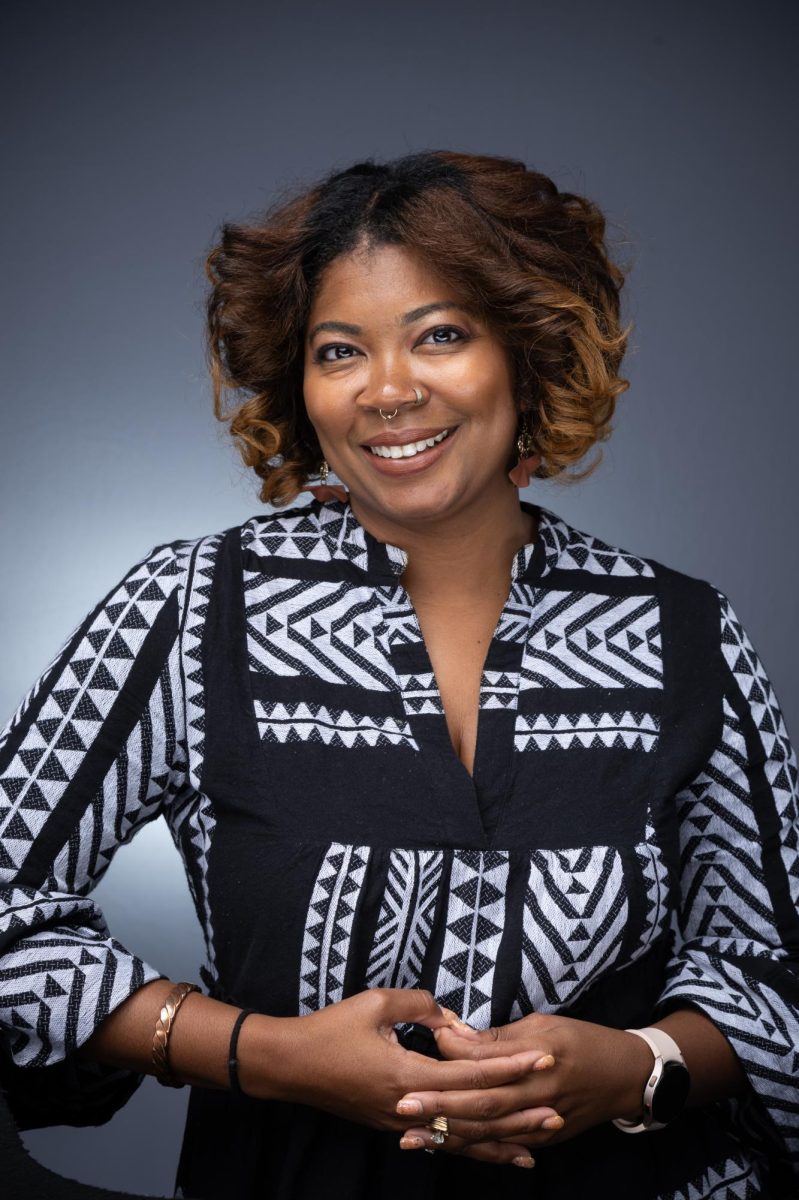
Dr. Quenna Barrett is the new artistic director for the Governors State theater. She’s also an assistant professor in the program at Governors State University. It’s her third year at the university, so she’s working on balancing the two.
As artistic director, she manages many responsibilities. “I work with other people in my department to choose the shows that we’re going to do for the upcoming season,” she said. “I manage our Instagram and Facebook pages, I direct in the season.” Barrett will be directing the upcoming spring play, “By the Way, Meet Vera Stark.”
To decide on what shows will be performed in the academic year, there is a meeting where both the Center for Performing Arts and the Theater and Performance Studies program meet to discuss what themes they want to cover in the next season. Themes are chosen based on what they feel students need to perform, what the audience wants to see, and a focus on variety. The theme for this year was legacy, which the shows “Anonymous” and “By the Way, Meet Vera Stark,” embodied.
Barrett explains that the process of choosing possible shows involves reviewing scripts, some more well known and some from local playwrights. She also observes other theaters in the area to see what’s being performed and what’s not being performed. While she was currently reading a local playwright’s work, the theater does not currently have a submission process because they don’t receive many submissions.
Asked if the theater would ever consider including a submission process for local playwrights, Barrett agreed that it would be possible idea for the future.
“You know, I don’t know, reading this play is making me think about it,” Barrett said. “I think I want to work with the Center for Performing Arts to see how we can do that, to really support playwrights. We’re a very small department; we have very finite resources. But we’re also a place that produces work, and so a local playwright might be interested in having their work in a smaller scale just to get it started.” Having experience in submission processes for local work, Barrett explained that it may be a lot of work and she’s unsure if the team has the capacity for it right now, but it’s something to consider.
Barrett said that the highlight of her position is working with the students: “I really do love interacting and working with our students. They come from different levels and training in experiences. Some have had really robust opportunities in theater, and some haven’t so much. So, we get to work with all levels, and I think in doing that, it helps me become a better artist and educator.”
Auditions for the upcoming play went well, Barrett said, and it’s going to remain a full production, although the program hasn’t received as many auditions as they have in the past. This fall, the theater had to move from a full production to a stage reading due to lack of auditions.
A challenge Barrett has for the upcoming show is how to portray the story and its characters, “It’s kind of examining race in Hollywood in the 1920’s, but also bringing it to a contemporary context,” Barrett said. “The racial identities of the characters, they’re different races. It’s written that way on purpose. But, most of the people who auditioned for the show were Black. And so now I have to figure out how do we tell this story that honors the way that it’s written, without any race feeling like we are stereotyping. But we still want to be able to put the show on, so how do we carefully depict the playwright’s intentions while still honoring everybody’s humanity.”
Other aspects of her role can also be challenging, Barrett said. “I think what’s challenging in this role in particular, is that I have primary responsibilities as a professor. But then on top of that, I’m also managing and building this program. I think it’d be helpful if the roles were kind of split, but this is what we have to work with currently. The program has been here for thirteen years, and the previous Artistic Director, Dr. Patrick Santoro did a wonderful job. I still feel like I’m new to the university, so I’m still just learning a lot, but also absorbing that role, just figuring how to manage it all.”
However, Barrett encouraged students to become involved with the theater, “Theater is such a collaborative effort and it takes many people doing lots and lots of different things. So, we welcome people if they’re interesting in exploring what that means or what it looks like.”
Students are able to perform in productions or work in crew, which includes backstage work such as costumes, lighting, stage work, etc.